


[PART 72]
DAY SIXTEEN: 17 September 1938
The Fourth Wave – The Ocean War Begins
We had fought the Martians for fifteen bloody days and had lost a great deal of territory along with hundreds of millions of lives to the terror of this off-world enemy but somehow we had managed to stop the Martians at many locations and at a few places we had even pushed them back. With all our losses it was still possible we could eventually defeat this brutal enemy even with all the weapons they still commanded. We had convinced ourselves all we needed to do was hang on and keep fighting. Yet when this new threat arrived it seemed for the first time all was possibly lost. We were running out of time and resources including territory to fight from. With this new force the balance of power, not yet on our side, was now decidedly with the Martians. Unlike our enemy we had no new reserves to bring into the fight. We would win or lose with what we had already deployed.
ZEUS FLASH: TO ALL COMMANDS: 200 PLUS MARTIAN CRAFT NOW ENTERING EARTH POLAR ORBITS. THIS IS A NEW GROUP OF MACHINES. EXPECT GREATLY INCREASED AIR ATTACKS AT ANY TIME.
We scrambled to notify our forces that a new wave of enemy craft had entered the war. We soon discovered this new group had a whole new objective beyond merely re-enforcing their ground forces already engaged. They would concentrate on the largest expanses on Earth – the oceans. This was at the time the one area where we still held the high ground and where a good deal of our combat strengths still lay.
It was not long before Martian machines began dropping out of orbit across much of the planet. Dozens flew directly towards their three command centers including Giza, but many more headed to the open oceans in groups of 25 to 30 in search of our most powerful group of warships – the carriers.
ATTACKS ON THE CARRIERS
By this time many of our air attacks were being launched from aircraft carriers stationed in the Pacific, Atlantic and Indian Oceans. The carriers were continuing their dogged attacks on a wide range of targets even as our air forces deployed on these ships was only 40% of their original complements. With fewer operational airfields on land especially in the Martian South we were depending more and more on our carrier task forces to bring the war to our enemy.
Many of the targets were well away from operational airstrips on land. And even though we knew these attacks could not in themselves win the war they had been instrumental in supporting our ground forces which in some cases had halted enemy advances and had even begun to turn back some of their attacks especially in and around heavily defended cities. It is also noted that although we had sustained great losses in the air we had lost only a few capital ships including carriers notably the Shoho and Neosho during the first week of the war. That record was about to be eclipsed.
On this day the Martians focused on our carrier forces launching simultaneous attacks on 46 of our carriers as well as their support ships across all three major oceans both north and south.
Along with a new group of Martian Flying Machines the enemy brought a class of combat craft to the battle we had not seen before – small but very powerful warships! They had brought a new group of tools in order to fight a completely different type of war on Earth not found anywhere on Mars – as Mars had not had an expansive ocean on its desiccated surface for many thousands of years. They deployed these warships directly onto the ocean’s surface from large carrier craft (mother ships) flown out of orbit. With limited radar reports it was difficult to track where these ships were being sent but one spotter was able to send a message on how they were deployed.
North of Henderson Island, South Pacific:
Submarine 64 Radio Burst Report, Pacific: LARGE MARTIAN FLYING CRAFT SET DOWN ON OCEAN SURFACE TO DEPLOY WARSHIPS FROM BACK OF CRAFT. FIVE SHIPS DEPLOYED FROM ONE MOTHERSHIP. MOTHERSHIP FLEW OFF. NEW MARTIAN WARSHIPS CRUISE AT ESTIMATED 6O KNOTS. EACH HEAVILY ARMORED AND DEPLOYING EIGHT HEAT-RAYS EACH… (Transmission ends)
Within a few hours of their deployment the fast moving Martian fleets began coordinated attacks on our carriers and ground-based airfields with support from Martian Flying Machines. Along with these warships the Martians were using very high-speed torpedoes which could not be intercepted by the gun crews on our ships. They were simply too fast. At thirty-five locations our carriers came under attack by dozens of these new ships and hundreds of flying machines. Even though we sent up every available fighter we had, many being pulled from air-to-ground support missions added to massed anti-aircraft fire from supporting warships our losses were substantial.
By the end of these first round of attacks we had lost 17 carriers including the Sea Plane Carrier Wakamiya, HMS Engadine, USS Ranger, USS Wasp, USS Saratoga, and the USS Washington in the Pacific; the HMS Valiant, HMS Defiant, HMS Victoria, USS Lexington and the CS Morgan in the Atlantic; and the CS Unity in the Indian Ocean as well as six others. We had also lost 23 battleships, 15 cruisers, 42 destroyers and 3 submarines, along with 243 Phoenix IIs and 43 Thunder Jets and 29 bombers.
During this first ocean wide attack the enemy had lost only three of their new warships, sunk by attack submarines along with 54 flying machines.
Most of these attacks had been focused on carrier groups which had been engaging in air attacks on point targets while operating on the open oceans. The next attacks would focus on carriers which had been deployed offshore in support of landing operations, evacuations and coastal city defense. Having controlled much of the land masses of Earth the Martians now shifted their main efforts to seize and control the vast oceans of Earth.
GIZA
The bomb group had marked their passage low over Bardai during a powerful dust storm. Even though they were operating their aircraft at full capacity it was clear they could not continue flying at such low altitudes in such massive wind driven sand and dust. They needed to gain altitude which meant, even though they were flying with our best anti-radar adaptations, possible exposure to Martian radars. As they crossed over Al Jawf in the Libyan Desert the three Phoenix IIAs climbed to 10,000 feet noting at the time a shift in the winds. They were now flying in the direction of the storm. If they were lucky it would take them all the way to Giza. Passing into Egypt they picked up the burst report relayed to all commands that new Martian Flying Machines were dropping out of orbit including into Giza. They made no attempt to contact their base to confirm the report as they were on radio silence. Just north of Asyut on the Nile they would see for themselves that the report had been accurate – very accurate!
As soon as the report came in the bomb was armed. At top speed they were only minutes from the target which should have been easy to spot having suffered damage from the earlier attack. To their dismay they discovered the attack on Giza expected to have ended hours earlier was still in progress and a massive dog-fight between them and their target was underway with the bomb group about to enter the fight. The bombers were gone but the fighters were still in the fight. Nearly 150 Phoenix IIs, Thunder Jets and Martian Flying Machines were buzzing around each other like angry bees fighting over a nest and the nest itself was sending out bolts from dozens of Heat-Rays into the fray. There was no chance this fight could be bypassed. As they excited the edge of the desert storm they flew directly into the firestorm.
With little time to react the bomb group did the only thing they could – they flew directly into the battle which was raging between them and the target they were attempting to deliver their payload to. Within seconds all three were engaged by Martian Flying Machines. The two escort Phoenix IIAs were able to rocket their way past several Martians downing one but with several more on their tails it was not long before both had taken hits and were going down. The atomic bomb armed fighter was on its own in a massive swarm of Martians.
Flying fast and still heading for Giza the last Phoenix IIA carrying the bomb picked up an escort Phoenix II; the pilot seemingly understanding this black painted fighter had bigger fish to fry than Martian Flying Machines. “Pilots escort the IIA. Keep those squids off his back. He’s heading for Giza.” Both jets along with two others which had come to assist continued on to the target while all around them the fighting raged. As one particularly aggressive Martian flew in to contact the small fast moving group the pilot of one port side Phoenix II escorting the group saluted the atomic bomb fighter and headed directly at the Martian craft exploding on impact. Seconds later a second Martian machine which had come at the flight from below fired its Heat-Rays hitting one of the escorts and the right wing of the Phoenix IIA. The Phoenix IIA began to spin wildly losing altitude fast causing the bomb to fly off its rack. A second later the last operational atomic bomb in our arsenal detonated in a blinding flash of intense energy.
The explosion instantly destroyed every aircraft in the battle.
One and a half seconds later the edge of the fireball along with the shock-wave slammed into the Martian Command Center at Giza. The damage on the surface of the center was extensive however the blast had been just far enough away to leave most of the underground base intact and operational. Some of the tunnels did collapse and there was a good deal of surface damage to the ancient structures but the center was still open for business.
The only way to completely destroy the complex was a ground burst inside the facility or in the air directly above. We had come close but not close enough. Once again despite our best efforts we had failed to destroy the Giza Complex. We would not get another chance.
MARTIAN FLIGHT SETTLEMENTS
Along with new combat forces the Martians had delivered into orbit two dozen large spacecraft designed to land on Earth and establish what could only be described as small self sustainable settlements. These Martian Flight Settlements were the largest Martian craft we had ever seen in Earth orbit. They were at least one full mile in diameter and designed to lie flat on the surface with no supporting legs, looking much like a flat sided domed plate. The occupation of Earth by non-combat Martian populations had begun.
Landings of these massive craft which included onboard self-defense military units were reported in the Martian South in southern Australia at Albany, Eucla and Mount Gambier; in South America at Calafate, Puerto Aisen and Rawson; in Southern Africa at Lambert’s Bay, Beaufort West and Durban as well as in Madagascar between Androko and Fort Dauphin.
In the north Martian Flight Settlements landed at Archangel, Nyurbe, Aldan, Nayakhan and Mayne Pylgino in the Soviet Union; north of Anchorage in Alaskan Territory; Hay River, Eskimo Point and Hebron in Northern Canada; Ivigtut in Greenland; Vestmannaeyjar in Iceland; east of Aberdeen in Northern Scotland; west of Stockholm in Sweden; and inside Helsinki in Finland.
They had landed these massive craft in areas which had been extensively covered with Red Weed and Red Fungus. They had planned well.
APOLLO FLASH: TO MAGIC DIRECTORS: MASSIVE MARTIAN CRAFT REPORTED LANDING IN FAR NORTH AND FAR SOUTH HEMISPHERES. AT LEAST TWO DOZEN REPORTED. CONFIRMATION AND INTELLIGENCE REQUESTED AS SOON AS POSSIBLE.
The Martians were not wasting any time occupying our planet at least in the coldest high latitude regions. Even though our damaged radars had not spotted any other massive craft in orbit more of these ships were expected to land in the near future. We would soon learn that each of these Martian Flight Settlements carried upwards of 10,000 Martians which meant this new wave of enemy alien craft had just delivered at least 240,000 Martians to planet Earth!
Most of the occupants were upper class Martian As with no more than a thousand Bs. It seemed the Martian Bs had been brought along to perform menial tasks as well as providing general security for the new ‘settlers’. They were as always lower on the social scale and thus completely expendable. The question was; would attacking and destroying these ‘settlements’ have any effect on the war? The Committee decided not to waste any efforts to attack these areas as they were not a direct military threat – at least not yet.
THE MARTIAN SOUTH
By the end of the sixteenth day of battle we had lost no fewer than 600 warships in the Martian South alone. The only active front lines below the equator were Burketown, Sydney, Southern New Zealand, French Guiana and Zaire. All of these fighting holdouts were now cut off from most outside support as the Martians reorganize to once again fight for control of the skies over the south. The only fully operational combat force we had remaining in the south were the submarines but over such a vast expanse of ocean they could do little on their own other than hit-and-run attacks on the Martian warships and deploying special operations combat teams to attack small Martian outposts. Nevertheless, re-supply of these submarines was still viable as most of the secret supply depots had not been located by the Martians. They could also be supported by our fleet of large supply and fuel submarines.
By now the only fully operational base we had on land in the south was the northern island of New Zealand surrounded by scores of warships and brisling with fighters and bombers. It was a formidable force we expected would be attacked at any time. It would become the last major battle in the Martian South.
Many of our remaining civilian shipping resources were being picked off by this new wave of Martian Flying Machines in conjunction with the new Martian warships. Local shipping of any kind was attacked with great losses. There were simply far too many of these mostly cargo ships to protect with our combat resources spread out so thin. Captains had been told to beach their ships and hide them as best they could in the hope that they could be recovered at a later date.
Island after island in the South Pacific were being attacked, mostly by Martian Flying Machines.
In the South Atlantic dozens of Martian Flying Machines attacked the isolated island of St. Helena in and around the capital of Jamestown. It was the only town on the 10.5 by 6.5 mile rugged volcanic island, where thousands were killed during the twenty minute attack. It would not be long before Martian forces landed on the remote island and began slaughtering those who had taken refuge.
There was one partial burst radio report indicating the Martians had once again occupied the South Pole. We had no confirmation but it would not be surprising to discover this to be accurate.
Triton onboard CS Pacific Ocean in central Pacific
TRITON VLF RADIO MESSAGE RELAYED TO POSEIDON AND NEPTUNE: TO ATTACK SUBMARINES PACIFIC – PRIMARY TARGETS OF OPPORTUNITY MARTIAN WARSHIPS – SECONDARY SUPPORT OF CARRIER TASK FORCES – GOOD HUNTING.
With their increased air capability the Martians began a two day sustained series of attacks supported by Martian warships counter-attacking our forces in the south including those conducting the invasion of the South Georgia Command Center. This new force eventually tipped the scales in their favor. Our forces had to withdraw but we had managed to severely damage the facility. Losses were heavy in both men and warships as we began to fight a bloody withdrawal from most military operations in the Martian South. In this battle alone we lost 250 ships including another five carriers.
THE NORTH
As the fighting intensified in the Martian South, Martian air operations in the north also increased but not at the same intensity. Nevertheless, the added strike capability of the enemies’ air power renewed Martian efforts to push hard at all fronts in the north particularly in China, Africa and the Soviet Union.
Martian Flying Machines in the north appeared to be split between continuing their attacks on our carrier forces and supporting front line units in areas where they were most likely to advance on the ground.
In China the ‘Shanghai Perimeter’ was under heavy air and ground attack on three sides; the area having been reduced by one third during the previous 24 hours. The Martians had concentrated their efforts on the southern front. No fewer than five carrier task forces deploying over 200 combat aircraft had now formed off Shanghai and Hangchow. This naval force, including 18 battleships, the strongest group in the North Pacific at this time, was also under attack from dozens of flying machines. Despite wave after wave of air attacks these forces had halted the Martians on the ground inflicting great losses on the enemy and had downed dozens of enemy flying machines. Several Martian ships had also attacked the perimeter of the massed naval force, but had not inflicted a great deal of damage and had in fact been beaten back by carrier and land based jets as well as attack submarines which had sailed in defense of the perimeter. In order to get to the fleet they would have to get past the fifteen submarines on patrol and not one Martian warship had yet been able to fight past these ships to attack the ‘Shanghai Perimeter’ directly.
Despite holding back the Martians at Shanghai, Yokohama fell on this day as the remaining Japanese fleet evacuated and re-organized itself around the island of Okinawa. The only active fighting on the Japanese main islands were small force guerrilla operations now cut off from any major outside support. They still had contact with the submarines.
In the Central Pacific the most recent message out of the Hawaiian Islands indicated the Martians were systematically sweeping the islands and killing every human they could find. We had not heard any messages from the underground cave facilities for two days but it was still possible these facilities had not been discovered. With strong Martian forces in the area rescue would not be possible. However, at least one submarine was able to land a recon team on the main island. It was not long before they were able to report. In the area they had landed not a single human could be found, at least not alive – not one!
In the United States strong American, Canadian and Committee forces continued to hold the lines both north and south. Martian ground forces had been redeployed from other areas and had re-enforced their lines. It was expected they would soon begin a major thrust on both fronts within a few hours. Martian air attacks along both fronts had increased in anticipation of renewed ground attacks. American air strikes were continuing on Martian ground concentrations.
On the continent of Western Europe renewed aerial attacks aided Martian ground forces pressing hard from the south and north attempting to link up. Several national and Committee armies were still fighting along a line from Munich, Vienna, and Budapest to Stalingrad. A second front in the mid-east centered around Ashkhabad and Kabul was still being held but was now completely cut off from supporting northern forces and any outlets to the sea. Fighting was reported heavy around Tehran and the Caspian Sea. Moscow had been radio silent for a day with nothing coming out of the area. The Moscow cable system had been cut. ‘Vodka Drinker’ was on his own.
In North Africa the only unoccupied area was a long oval-shaped area between Kiffa on the west and Bardai on the east. It would not be long before the entire area was overrun.
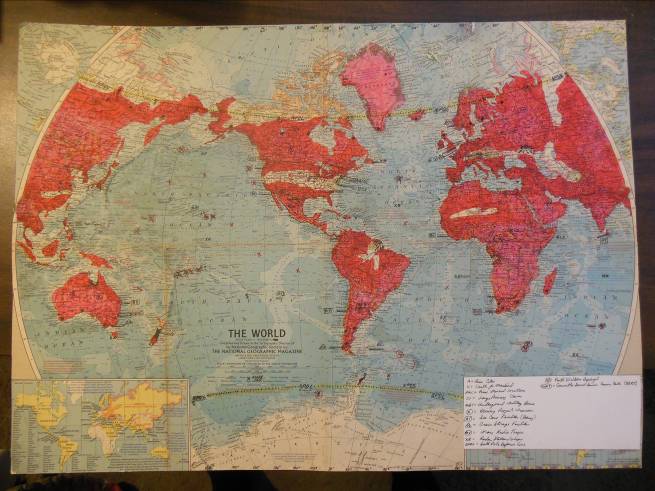
Martian primary attacks and occupied territories – 17 September 1938
DAY SEVENTEEN: 18 September 1938
The Fifth Wave – The Extermination of the Human Race
On the seventeenth day of the war the Martians continued their renewed heavy air attacks on surface ships still concentrating on our carrier forces. Our remaining forces in Australia began their fighting withdrawal from Burketown and Sydney. We simply did not have enough resources to hold on in Australia as the Martians increased their ground forces and heavy air attacks. New massed attacks had made these areas untenable as Australian and Committee forces fought a delaying action. The withdrawal was well organized and well supported. Despite renewed Martian efforts both areas closed in on themselves in orderly fashion which allowed many of our units to safely retreat to waiting ships which transported thousands to the North Island of New Zealand. In both areas thousands of volunteers had grouped themselves into small combat teams which infiltrated into the Australian outback for rear area operations. They would continue the war as long as they could with hit-and-run attacks.
By 1400 hours local time national and Committee forces ceased combat operations at Burketown. At Sydney all critical Lower-Sydney operational areas important to the Martians were destroyed or sealed off. Nothing of value was left for the Martians. Classified records were loaded on Committee submarines and removed to New Zealand. Two hours later military operations at Sydney ended. We had lost all of Australia including our southern command city. New Zealand was now the only large landmass still held by humanity in the Martian South.
NEW ZEALAND
The first major attack of the day from Martian ground forces in the south came on the southern island of New Zealand attempting to regain what they had earlier lost. It began with heavy fighting along the entire front. Thus, would begin a two-day fighting withdrawal of our forces from the southern island. It would be one of the bloodiest battles in the south with very heavy casualties on both sides. As was their way the Martians paid no attention to their losses as they were determined to press forward at all costs. As our forces retreated north hundreds of jets pounded Martian front line units while Phoenix IIs flew air cover engaging every Martian Flying Machine in the area. At the same time dozens of our warships pounded the flanks of their advances slowing them down but did not halt their advance.
At the same time the Martians began sustained air attacks on the Northern Island. Their efforts in the north would be costly as we still held air superiority over much of New Zealand. For the most part these attacks were directed at infrastructure including electrical and communication grids, rail lines, bridges and supply depots.
Re-enforced by tens of thousands of combat troops from several South Pacific areas the northern island of New Zealand now held well over one million men under arms. The seas around the island nation saw over 450 warships including seven carrier groups and 200 support ships which completely encircled the island. 1000 other ships of all kinds dropped anchor off the coast taking cover as they could. Combat aircraft numbered well into 820 with an additional 240 cargo aircraft in hangers. This was the largest human combat force remaining in the entire southern hemisphere and even though supplies were limited there was no thought of surrender.
Titan sent a message to our command center in Lower-New York City informing Apollo he could hold out without re-enforcement for at least two weeks in New Zealand. He was prepared to engage any enemy forces he could find and would concentrate on destroying the enemies’ air and naval forces. He also reported the loss of Sydney.
Unknown at the time a small but powerful Martian fleet had landed off the southern island of New Zealand and was moving towards northern New Zealand. They would soon be engaged in the largest and final sea battle of the war.
ZAIRE
This day would also mark an end to fighting on the west coast of Africa at Zaire. Newly re-enforced Martian ground forces backed by heavy air and sea efforts effectively ended our resistance along that hotly contested battle front. Surviving individuals and small units made their ways to the interior as best they could to begin guerrilla operations. They would be few in number. With very limited supplies and no chance of re-supply their efforts were not expected to hold much promise. Nevertheless, messages were intercepted from these units stating they would concentrate on attacking concentration camps in order to rescue as many people as possible.
The few ships able to successfully evacuate the area had few options. Some would sail off to small relatively nearby islands but most would begin a long and dangerous voyage north-west in an attempt to reach the east coast of the United States or west to the north coast of South America at French Guiana. Most would not survive the trip. Even those few who were able to cross the Atlantic on the 4000-mile voyage would learn too late the sanctuary they had sought no longer existed.
FRENCH GUIANA
The fighting forces which had held back the renewed efforts of the Martians to take this last hold out in South America finally succumbed to a massive three-pronged attack by re-enforced Martian ground forces and several high-speed Martian combat ships covered by dozens of Martians Flying Machines. The fighters had made their last stand with their backs to the sea. As at Zaire only a handful of ships were able to fight their way out of the carnage and sail north to hopefully make it to the east coast of the United States.
Thousands were able to escape into the jungle which seemed to hold a special fear for the Martians. There are no jungles on Mars. We estimated nearly a million more people led by local scouts were now hiding in what remained of the great Amazon jungle from the fighting around French Guiana alone. At least ten million had taken refuge in the thick equatorial forest which would turn out to have been one of the safest places on Earth to hide from the Martians.
ST. HELENA
The island refuge saw its first Martian landing in the early morning hours at Jamestown beginning at 6:55 a.m. local. The few military forces stationed on the island immediately engaged the enemy on the beach at St. James Bay. Days before the invasion began re-enforcements had been arriving from Africa along with the thousands of refugees. Even though several warships were able to give some fire support it was not long before these meager forces were beaten back to the interior of the island and a beachhead secured.
During the first wave of attacks 200 flying machines sunk 8 battleships, 7 cruisers, 28 destroyers and five submarines. We also lost 80 Phoenix IIs and 97 jet fighters.
Every available warship in the area made flank speed towards the island in an effort to arrive before all was lost. By the end of the day half the small island was in Martian ‘hands’ and tens of thousands were dead. Those who fled the brutal attacks in Africa would now meet the same fate 1200 miles off the coast on this volcanic retreat. It was only a matter of time.
THE FINAL PUSH
From the number of new landings, it was clear the Martians were beginning a final massive push for complete domination of the last land masses of Earth still controlled by mankind. Almost all of the final Martian craft in Earth orbit were dropping out and landing in just about every operational area still held by the military forces of mankind. As far as the Martians were concerned the final phase of the second “war of the worlds” had begun.
Many of this final wave landed near our remaining command cities in what appeared to be a last attempt to knock out the remaining military and civilian authorities on Earth. When confirmation of these landings were made their targeted locations were wired to military forces still operational around the world and still capable of fighting these Martian invaders.
Landings were made south and south east of New London, near Munich, Vienna, Moldavia, Odessa, Baku and Chardzhou in Europe. In the United States landings occurred outside New York City, Philadelphia, Baltimore, New Washington Center and Charlotte. A Martian fleet was now attacking New York City and were expected to land ground combat forces at any time. Defensive forces were prepared to welcome them with a massive lethal show of force. Just before they landed, our subs ‘removed’ three of their larger landing craft just before they could deposit their forces.
In the Martian South the enemy landed on the northern island of New Zealand at Whangarei, Gisborne, Hastings and Palmerston North. At the same time the southern Martian fleet began their all out attack on the massive Committee fleet which had gathered around the northern island. A second Martian fleet was now engaged off the coast of Shanghai and Hangchow.
APOLLO FLASH: TO ALL COMMANDS: THE MARTIANS HAVE COMMITTED A FINAL MASSED ATTACK FOR DOMINATION OF EARTH UNDERWAY AT PRIMARY COMMAND CENTERS. PLAN OMEGA. BE PREPARED FOR GENERAL GUERRILLA OPERATIONS. CONTINUE TO ENGAGE THE ENEMY AT ALL POSSIBLE POINTS. ENACT A FEARSOME PRICE ON THESE INVADORS AND SHOW THE ENEMY HUMANITY WILL NEVER SURRENDER. FOCUS ON ENEMY COMMAND AND CONTROL. DO NOT GO QUIETLY INTO THAT DARK NIGHT. GOOD LUCK AND GOOD HUNTING.
All seemed lost! We knew within mere hours our backs would be to the wall and it would be over. We would not be able to contact most of our remaining combat forces if our command cities fell. Messages were sent ordering ‘Plan Omega’ into operation. This order gave local commanders full authority to establish military commands and full control over those areas. They would now assume responsibility for deciding how and when to attack as well as control over any and all civilian populations and supplies. All of our Committee forces would now fight independently as guerrilla units. For the most part they would be on their own. How long one could expect these forces to engage the enemy was anyone’s guess.
The final message sent to our New London Committee headquarters from New York City indicated that the Martians had entered Lower-New York City at several points and they were now engaged in fierce hand-to-hand combat. Evacuations were underway as forces were fighting to open an avenue for the evacuation to outlying areas. The Committee was informed they would continue to fight as long as they had the ability to fight. Their final message was cut off in mid sentence.
In New London our Command group had decided not to evacuate. We would make our stand in New London. As we stood by our weapons with the sounds of approaching battle ringing in our ears we became aware of a sound we would not have expected and it was overwhelming – silence.
Beneath our feet we could feel a slight trembling and then a buzzing in our ears which began to increase until it became a roar. What were the Martians up to? We soon discovered what the trembling and roaring meant and it had nothing to do with another Martian attack or some new Martian weapon. It was something mankind could never have imagined and something we would never completely understand. Planet Earth was not just trying to recover, the damn planet was fighting back!
[END PART 72]
Copyright © R. Michael Gordon, 2020


